


Choosing the right conveyor belt material is not only about comparing whether PVC, PU, or rubber has the lower price. It is about whether the material matches the actual working conditions. The conveyed product, operating temperature, cleaning method, surface friction, pulley diameter, food-contact requirements, and expected service life all affect the final selection.
This guide explains common conveyor belt materials, application industries, surface patterns, structural parameters, and purchasing considerations to help you decide which conveyor belt material is more suitable for your production line.
Why Conveyor Belt Material Affects the Performance of the Entire Conveyor Line
The conveyor belt material directly determines how the belt body contacts the conveyed product. Different materials vary in surface friction, wear resistance, flexibility, cleanability, oil resistance, temperature resistance, and tensile strength, so they directly affect the stable operation of the conveyor line.
For example, a standard packaging line usually focuses on smooth conveying, controlled cost, and wear resistance. A food processing line is more concerned with cleanability, food-contact suitability, and reducing residue and contamination risks. A logistics sorting line needs to consider wear resistance, impact resistance, and joint strength during long-term operation. An electronics assembly line may also require anti-static performance, a clean surface, and product protection.
If the selected material does not match the application, the belt may slip, track poorly, wear on the surface, crack, delaminate, fail at the joint, or become difficult to clean. For production companies, these problems are not only about replacing one conveyor belt. They may also cause downtime, rework, product contamination, or higher maintenance costs.
Therefore, when selecting conveyor belt materials, you should not look only at material names such as PVC, PU, or rubber, and they should not make decisions only based on price. A better approach is to first confirm the conveyed product, operating environment, conveying angle, temperature range, cleaning method, pulley diameter, and whether special processing is required. Then you can decide which material, structure, and surface pattern are suitable.
A suitable conveyor belt should meet the requirements of equipment operation, product conveying, and later maintenance at the same time. When the material is selected correctly, the conveyor line can run more stably and belt service life becomes more predictable.
Common Types of Conveyor Belt Materials
Different conveyor belt materials are suitable for different conveying environments. For you, the material name is only the first step. It is more important to understand the performance boundaries, suitable industries, and common limitations of each material. The following are several common conveyor belt materials used in industrial conveying systems.
PVC Conveyor Belt Material
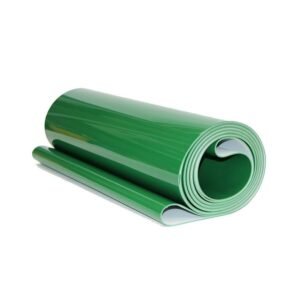
PVC is one of the most widely used materials for light-duty conveyor belts. It is commonly used in packaging, logistics, warehousing, airport baggage handling, carton conveying, electronics assembly lines, and general industrial conveying applications.
The advantages of PVC conveyor belts are controlled cost, rich surface pattern options, and strong processing adaptability. Depending on conveying requirements, PVC belts can be made with smooth, diamond, rough top, saw tooth, anti-slip, or other surfaces. For most light-duty and medium-light-duty conveyor lines, PVC is a practical material choice.
However, PVC is not suitable for all working conditions. If the production line is exposed to long-term high temperatures, heavy oil contamination, strong solvents, or high hygiene requirements, a standard PVC conveyor belt may not be the best option. In such cases, the temperature, cleaning method, food-contact requirement, and chemical exposure should be checked to determine whether PU, silicone, PTFE, or another specialty material is needed.
PU Conveyor Belt Material
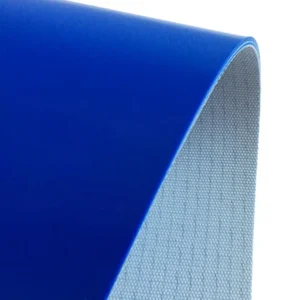
PU, or polyurethane, is commonly used in food processing, bakery, confectionery, chocolate, packaging, pharmaceutical, and other conveying applications that require better cleanability.
Compared with standard PVC, PU conveyor belts usually offer better flexibility, wear resistance, and cleaning performance. For production lines that require frequent cleaning, direct or indirect food contact, oil contact, or a more hygienic belt surface, PU is often a more suitable choice.
In the food industry, you should not simply assume that a white conveyor belt is food grade. Correct selection depends on whether the material is suitable for food contact, whether it is easy to clean, whether the joint and edges can trap dirt, and whether the belt will contact oil, moisture, or high-temperature products. For bakery, dough, chocolate, candy, and similar applications, PU is often more worth considering than standard PVC.
PE Conveyor Belt Material
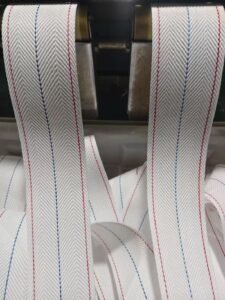
PE conveyor belt material is commonly used in some light industrial applications, wood processing, panel conveying, and environments that require water resistance or low water absorption.
PE is relatively lightweight, has good water resistance, and provides a stable surface in certain wet or dusty environments. For example, in wood processing, panel conveying, or some light-duty material handling applications, PE conveyor belts can be selected according to surface structure and belt strength.
However, PE is not a universal material for every application. Its high-temperature resistance, wear resistance, and impact resistance must be evaluated together with the specific belt structure. You should not look only at the material name “PE”; they should also confirm thickness, number of plies, surface pattern, bottom structure, and the actual conveyed product.
PVK Conveyor Belt Material
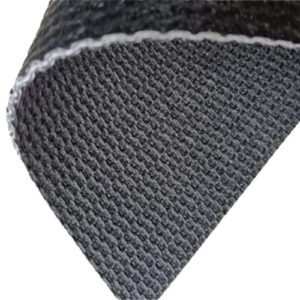
PVK conveyor belts are commonly used in logistics, express parcel sorting, warehousing, airport baggage handling, and high-frequency parcel conveying applications.
This material usually provides good wear resistance and impact resistance, making it suitable for long-term operation, frequent friction, and applications where parcels repeatedly impact the belt surface. For cartons, express parcels, bagged goods, luggage, and similar products, PVK belts are often more suitable than standard light-duty PVC belts for high-frequency industrial use.
PVK conveyor belts are often black or dark in appearance, and the surface usually has a stronger friction feel, which helps improve conveying stability. For logistics sorting lines, You should focus on belt thickness, joint strength, surface friction, running speed, and equipment pulley diameter when selecting PVK.
Rubber Conveyor Belt Material
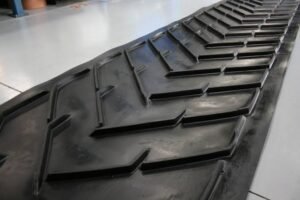
Rubber conveyor belts are more commonly used in heavy-duty industrial applications, such as mining, quarrying, aggregate, cement, steel, coal, and bulk material handling.
Rubber materials offer strong wear resistance, impact resistance, and load capacity, making them suitable for conveying rough, heavy, or impact-intensive materials. However, their application direction is different from that of light-duty belts such as PVC, PU, PE, and PVK. Rubber belts are more suitable for heavy bulk material handling, while light-duty conveyor belts are more often used in food, packaging, logistics, electronics, pharmaceuticals, wood processing, and general industrial conveying.
Therefore, you should first determine whether they need a heavy-duty rubber conveyor belt or a light-duty industrial conveyor belt. If the application is a packaging line, food line, airport baggage line, logistics sorting line, or electronics assembly line, PVC, PU, PE, and PVK light-duty conveyor belt materials are usually more appropriate options.
Silicone Conveyor Belt Material
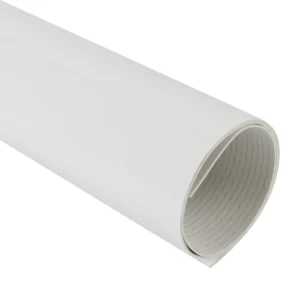
Silicone conveyor belts are mainly used in special conveying applications related to high temperature, non-stick performance, and food processing, such as bakery, thermal processing, food cooling, and conveying before or after heat sealing.
The main advantages of silicone are high-temperature resistance, softness, and non-stick performance. It is suitable for conveying products that are sticky or relatively hot. In bakery applications, silicone belts are often used at workstations where non-stick performance and heat resistance are needed.
However, silicone conveyor belts are not necessarily suitable for high-wear or high-impact environments. Their strengths are heat resistance, non-stick behavior, and softness, rather than heavy-load carrying capacity or long-term strong friction. Whether silicone should be selected depends on whether the production line truly requires high-temperature resistance, non-stick performance, or special food-contact properties.
PTFE / Teflon Conveyor Belt Material
PTFE, also commonly called Teflon, is suitable for high-temperature, non-stick, chemical-resistant, and drying applications. Common uses include drying lines, heat sealing machines, coating lines, laminating lines, food baking, and some chemical conveying environments.
PTFE offers strong high-temperature resistance, non-stick performance, and chemical resistance, making it suitable for high-temperature or chemical environments where standard PVC or PU cannot perform. However, it is a more specialized conveyor belt material. Its cost is usually higher, and the selection depends more heavily on actual working conditions.
If the production line involves high temperature, you should not only ask whether a high-temperature conveyor belt is available. They should provide continuous temperature, instantaneous temperature, contact time, product condition, and whether the belt will contact oil or chemicals. Only then can the supplier determine whether PTFE, silicone, or another specialty material is required.
Felt and Fabric Conveyor Belt Materials
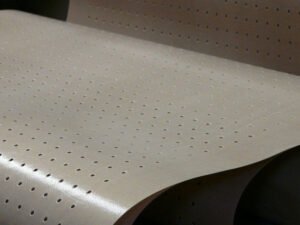
Felt and fabric conveyor belts are often used where product surface protection, reduced scratching, or soft contact is required. For example, felt or fabric-surface conveyor belts may be used for panels, aluminum profiles, glass, paper products, textiles, cutting equipment, and some precision workpieces.
The core value of these materials is not high strength or high-temperature resistance, but product protection, surface cushioning, and stable contact. For products that are easily scratched, pressed, or marked on the surface, felt or fabric-surface belts can reduce hard contact between the product and the belt.
However, felt materials are usually not suitable for high-moisture, heavy-oil, or high-hygiene direct food-contact environments. Selection should be based on product surface requirements, cleaning method, running speed, and whether the surface easily absorbs dust.
Conveyor Belt Material Comparison Table
No conveyor belt material is absolutely good or bad. The key is whether it suits the specific working conditions. When selecting materials, you can compare wear resistance, cleanability, food-contact requirements, temperature resistance, oil resistance, load capacity, surface friction, and cost.
| Conveyor Belt Material | Main Advantages | Common Applications | Main Limitations | Best Suited For |
| PVC | Controlled cost, rich surface pattern options, easy processing, wide application range | Packaging lines, warehouse logistics, airport baggage, electronics assembly, general industrial conveying | Not suitable for long-term high temperature, heavy oil, strong solvents, or high-hygiene applications | General light-duty and medium-light-duty conveying |
| PU | Good flexibility, wear resistance, easy to clean, suitable for food-related applications | Food processing, bakery, candy, chocolate, pharmaceuticals, packaging | Usually higher cost than standard PVC; temperature grade still needs confirmation | Food, clean, and higher-hygiene conveyor lines |
| PE | Lightweight, good water resistance, low water absorption | Wood processing, panel conveying, some light industrial and wet environments | High-temperature resistance, wear resistance, and impact resistance depend on the specific structure | Wet environments, light materials, and some panel conveying |
| PVK | Good wear resistance, stronger impact resistance, suitable for high-frequency operation | Express sorting, warehousing, logistics lines, airport baggage handling | Not suitable for direct food contact; flexibility must be checked for small pulley systems | High-intensity logistics sorting and parcel conveying |
| Rubber | Strong load capacity, wear resistance, impact resistance, suitable for rough materials | Mining, aggregate, cement, coal, steel, bulk materials | Heavy weight; not suitable for most light-duty, clean, or food-grade conveyor lines | Heavy-duty bulk material handling |
| Silicone | High-temperature resistance, softness, good non-stick performance | Bakery, thermal processing, food cooling, conveying before or after heat sealing | Not suitable for high-wear, high-impact, or heavy-duty applications | High-temperature, non-stick, and food heat-treatment applications |
| PTFE / Teflon | High-temperature resistance, non-stick performance, chemical resistance | Drying lines, heat sealers, coating lines, laminating lines, food baking | Higher cost; specialty material for specific working conditions | High-temperature, non-stick, and corrosion-resistant applications |
| Felt / Fabric Surface | Soft contact, product surface protection, reduced scratching | Panels, aluminum profiles, glass, paper, textiles, cutting equipment | Not suitable for high-moisture, heavy-oil, or high-hygiene direct food contact | Products that require surface protection and cushioning |
From this comparison, PVC, PU, PE, and PVK are more oriented toward light-duty industrial conveyor belt materials and are suitable for packaging, food, logistics, electronics, wood processing, and general industrial conveying. Rubber conveyor belts are more focused on heavy-duty bulk material handling, while silicone and PTFE are more often used for high-temperature, non-stick, or chemical-resistant applications.
Therefore, in actual procurement, you should not order only according to the material name. For example, even among PVC conveyor belts, different numbers of plies, thicknesses, surface patterns, bottom structures, and hardness levels can affect performance. Similarly, for PU conveyor belts, you still need to confirm whether the belt is suitable for food contact, whether edge sealing is required, and whether it will contact oil or moisture.
A more reliable selection method is to first confirm the conveyed product and operating environment, and then choose the proper belt structure according to material characteristics. For replacement belts, customers should also provide photos of the old belt, width, length, thickness, surface pattern, bottom structure, and equipment pulley diameter so the supplier can recommend the material and specification more accurately.
How Conveyor Belt Structure Affects Material Performance
When selecting a conveyor belt material, you should not look only at material names such as PVC, PU, PE, or PVK. Even with the same material, different numbers of plies, thicknesses, surface structures, bottom structures, hardness levels, and pulley compatibility requirements can create completely different performance results.
For you, the material determines the basic performance of the conveyor belt, while the structure determines whether the belt can stably match the specific equipment and working conditions.
Number of Plies
The number of plies usually refers to the number of internal fabric layers in the belt, such as 1-ply, 2-ply, 3-ply, or more. The number of plies affects tensile strength, dimensional stability, deformation resistance, and total belt thickness.
In general, more plies usually provide higher strength and stability, making the belt more suitable for longer conveying distances, higher tension, or medium-load applications. However, as the number of plies increases, the belt may become thicker and stiffer, and the required pulley diameter may also increase.
Therefore, more plies are not always better. For small conveyors, knife-edge conveyors, or equipment with small pulley diameters, a belt that is too thick or too stiff may cause difficult bending, joint cracking, or unstable operation.
Thickness
Belt thickness affects wear resistance, flexibility, service life, and equipment compatibility. A thicker conveyor belt is usually more wear-resistant and more suitable for handling some impact and long-term operation. A thinner belt is usually more flexible and more suitable for small pulleys, light-duty conveying, or equipment that requires better wrapping around rollers.
However, thickness alone cannot determine whether a belt is suitable. For a light packaging line, an overly thick belt may increase running resistance and motor load. For a logistics sorting line, an overly thin belt may not withstand long-term friction and parcel impact.
The correct approach is to evaluate the proper thickness based on conveyed product weight, belt speed, running time, pulley diameter, and operating environment.
Surface Structure
The top surface of the conveyor belt directly contacts the product, so the surface structure affects friction, anti-slip performance, cleaning difficulty, and product protection.
Smooth conveyor belts are suitable for stable conveying and easy-cleaning applications, such as food, packaging, electronics, and general light industrial conveying. Rough top, diamond, saw tooth, or other anti-slip patterns are more suitable for inclined conveying, carton conveying, bagged goods, or applications that require higher grip.
However, stronger anti-slip performance does not mean a surface is suitable for every application. Deeper patterns are usually more difficult to clean and may not be suitable for some high-hygiene or direct food-contact applications. Surface pattern selection should be based on conveying angle, product shape, cleaning requirements, and industry standards.
Bottom Structure
The bottom side of the conveyor belt contacts rollers, slider beds, or guide rails. It affects running resistance, noise, wear resistance, and tracking stability. Common bottom structures include fabric bottom, smooth bottom, low-noise bottom, or other special bottom structures.
If the conveyor line uses a slider bed, bottom-side wear resistance and running resistance are important. If the equipment runs at high speed, bottom stability and noise control should also be considered. If the pulley diameter is small, bottom flexibility can also affect whether the belt can pass smoothly around the rollers.
Many buyers focus only on the top surface and ignore the bottom structure. In reality, the bottom structure directly affects whether the belt runs smoothly and how much wear or tracking risk appears during long-term operation.
Hardness
The surface hardness of a conveyor belt affects product support, friction behavior, and product protection. A harder surface usually provides better support and is less likely to deform, making it suitable for products with stable shapes or heavier weights. A softer surface is more suitable for applications that require cushioning, surface protection, or reduced scratching.
For example, cartons, parcels, wood panels, and metal parts require different surface hardness levels. Food, dough, chocolate, and precision electronic components also need different surface materials and hardness levels depending on the contact method.
If the surface is too soft, product conveying may become unstable or belt wear may accelerate. If the surface is too hard, it may cause dents, scratches, or sliding problems on the product surface.
Minimum Pulley Diameter
Minimum pulley diameter is an easily overlooked but very important parameter in conveyor belt selection. Each conveyor belt has a suitable minimum roller diameter requirement, which is related to material, number of plies, thickness, hardness, and bottom structure.
If the equipment pulley diameter is too small while the belt is too thick, too stiff, or has too many plies, repeated bending may cause cracking, delamination, joint damage, or significantly shorter service life. This is especially important for small conveyors, curved conveyors, knife-edge conveyors, or equipment with frequent starts and stops.
Therefore, when purchasing a replacement conveyor belt, you should provide not only width and length but also pulley diameter or equipment photos. This allows the supplier to determine whether the selected material and structure are suitable for operation, rather than quoting only according to dimensions.
Joint Method
Whether the conveyor belt needs to be made endless and which joint method is used can also affect final performance. Common joint methods include hot-pressed joints, finger joints, and mechanical fasteners. Different materials, thicknesses, and applications require different joint methods.
Food, packaging, and electronics industries usually care more about joint flatness and running stability. Logistics and airport conveying applications care more about joint strength and impact resistance. Equipment that requires frequent disassembly may sometimes use mechanical fasteners.
If the joint method is not suitable, the belt may jump, crack, delaminate, or fail prematurely at the joint even if the material itself is correct.
Custom Processing Structure
Many conveyor belts are not simple flat belts. They need to be customized according to the equipment and working conditions, such as adding guide strips, cleats, perforations, grooves, edge sealing, sidewalls, special-size cutting, or surface processing.
These processing structures further affect how the conveyor belt runs. Guide strips can help position the belt and reduce tracking problems. Cleats can help lift or separate materials. Perforations can be used for vacuum, drainage, or positioning. Edge sealing can reduce edge water absorption, delamination, or contamination risk.
Therefore, for actual procurement, conveyor belt material is only the starting point. Only when material, structure, and processing method are considered together can you obtain a conveyor belt that truly suits the production line.
Conveyor Belt Surface Patterns and Applications
The surface pattern of a conveyor belt determines the friction behavior between the belt and the product. Even when two conveyor belts use the same material, different surface patterns can produce different results in anti-slip performance, cleanability, conveying stability, and product protection.
Therefore, when selecting a conveyor belt, you should not look only at the material. They also need to choose a suitable surface structure according to conveying angle, product shape, product weight, whether the surface is easily scratched, and whether the belt needs to be cleaned.
Smooth Conveyor Belt
Smooth conveyor belts have a flat surface and are easy to clean. They are suitable for horizontal conveying, light-duty conveying, and applications with higher hygiene requirements. Common uses include food processing, packaging lines, electronics assembly lines, pharmaceutical conveying, and general light industrial conveying.
The advantages of a smooth surface are stable operation and easy cleaning. It is less likely to trap dirt. If the conveyed product is stable, the conveying angle is small, and strong anti-slip performance is not required, a smooth conveyor belt is usually a suitable choice.
However, if the conveyor line has a clear incline or the product tends to slide, a smooth belt may not provide enough friction. In this case, you may need to consider diamond, rough top, saw tooth, or other patterned surfaces, or add cleats and guide strips.
Diamond Pattern Conveyor Belt
A diamond pattern conveyor belt has a regular rhombus-shaped surface pattern, which can increase surface friction while still maintaining a certain level of cleanability. It is often used for cartons, packaged goods, light bagged products, logistics conveying, and low-angle incline conveying.
Compared with rough top belts, the diamond pattern is usually more regular and relatively easier to clean. Compared with smooth belts, it provides better anti-slip performance. Therefore, when slight anti-slip performance is needed but the surface should not be too rough, diamond pattern is a common choice.
You should note that diamond pattern is not suitable for every inclined conveying application. If the incline angle is large or the product bottom is slippery, rough top, saw tooth, or cleated belts may still be required.
Rough Top Conveyor Belt
Rough top conveyor belts have higher surface friction and are mainly used for anti-slip conveying, inclined conveying, carton conveying, bagged goods, and packaged products. Their main function is to increase grip between the belt and the product, reducing slipping or sliding during conveying.
In logistics, warehousing, packaging, and some industrial conveyor lines, rough top PVC conveyor belts are widely used. For example, cartons, woven bags, parcels, or other products with slippery bottoms often require a higher-friction surface during inclined conveying.
However, rough top belts also have limitations. Because the surface texture is deeper, cleaning is usually more difficult than with smooth belts. They may not be suitable for applications that require frequent cleaning or direct food contact with high hygiene requirements. If used in the food industry, material grade, cleanability, and residue risks must be checked further.
Saw Tooth Conveyor Belt
Saw tooth conveyor belts have directional surface patterns that provide stronger anti-slip and grip performance. They are suitable for inclined conveying, lifting, and conveying products that tend to slide.
This surface is often used for cartons, packaged goods, light bulk materials, bagged products, or conveyor lines that require a certain climbing capability. Compared with smooth or shallow-pattern belts, saw tooth surfaces can more effectively reduce product slipping during conveying.
However, saw tooth surfaces are not always suitable for industries with high cleaning requirements. The more obvious the pattern, the more attention should be paid to whether dust, debris, moisture, or food residue will accumulate in the pattern. Therefore, in food, pharmaceutical, or high-cleanliness applications, this surface should be selected carefully.
Herringbone and Anti-Slip Conveyor Belts
Herringbone, anti-slip, and similar directional patterns are usually used where stronger friction and a certain lifting ability are required. They help keep materials stable during inclined conveying and reduce rolling, sliding, or accumulation.
These surfaces are common in packaging, logistics, agricultural products, wood processing, and some light industrial applications. If the conveyed material has some weight or the conveyor angle is relatively large, smooth or shallow-pattern belts may not be sufficient, and herringbone or stronger anti-slip patterns may be more suitable.
It should be noted that stronger surface patterns also increase friction between the belt and the product. This may increase wear or cleaning difficulty. Selection should balance anti-slip performance, cleaning requirements, and service life.
Matte Surface Conveyor Belt
The friction performance of a matte surface conveyor belt is usually between a smooth surface and a rough top surface. It is not as slippery as a smooth belt, but it is not as deeply textured as a rough top belt. Therefore, it is suitable for applications that require stable contact but do not want an overly rough surface.
Matte surfaces can be used in packaging, light industry, electronics, paper products, and some food-related applications. They can reduce slight product movement during conveying while maintaining relatively good cleanability and stability.
If the product surface is easily scratched or the belt surface should not leave obvious marks on the product, a matte surface may be more suitable than a deep-pattern surface.
Felt Surface Conveyor Belt
Felt surface conveyor belts are mainly used for product protection and soft-contact applications. Their softer surface can reduce scratching, dents, or hard contact during conveying.
Common applications include aluminum profiles, glass, panels, paper products, textiles, cutting equipment, and some precision workpieces. For products with high surface requirements, products that are easily damaged, or products that require cushioning, felt conveyor belts can provide better protection.
However, felt surfaces are not suitable for every environment. They can absorb dust, debris, moisture, or oil, making cleaning more difficult. Therefore, they are not suitable for high-moisture, heavy-oil, or high-hygiene direct food-contact applications.
Checker and Special Pattern Conveyor Belts
Checker, dot, stripe, and other special surfaces are usually used for specific conveying requirements, such as increasing local friction, improving product positioning, reducing sliding, protecting the product surface, or meeting certain equipment requirements for belt surface structure.
Selection of these conveyor belts depends more heavily on the actual application. You should provide photos of the existing belt, the conveyed product, equipment structure, and conveying angle. The supplier can then determine whether the same pattern is needed or whether another surface can be used as a replacement.
For customers replacing an old conveyor belt, if the original surface pattern name is unknown, the most direct method is to take clear photos of the belt surface and provide belt thickness, width, length, and bottom-side photos. This can reduce the risk of choosing the wrong pattern or material.
In summary, conveyor belt surface patterns are not decorative. They are important structures that affect conveying performance. Smooth surfaces are more suitable for clean and stable conveying, rough top and saw tooth patterns are more suitable for anti-slip and inclined conveying, and felt surfaces are more suitable for product protection. Only by considering material, pattern, and application together can you choose a conveyor belt that truly suits the production line.
How to Choose Food-Grade Conveyor Belt Materials
Food-grade conveyor belt material selection should not be based only on color. White, blue, and green conveyor belts are common in the food industry, but color itself does not prove that the material is suitable for food contact. The real questions are whether the material is suitable for food-related applications, whether the surface is easy to clean, whether joints and edges may trap dirt, and whether the belt will contact moisture, oil, sugar, dust, or cleaning agents.
PU conveyor belts are usually more suitable for food processing, bakery, candy, chocolate, pharmaceuticals, and other applications with higher cleanability requirements. Compared with standard PVC, PU generally offers better flexibility, wear resistance, and cleaning performance. It is more suitable for frequent cleaning, direct or indirect food contact, oil contact, or production lines with higher hygiene requirements. Food-grade PVC can be used for some dry foods, packaged foods, or less demanding direct-contact scenarios, with advantages in cost and processing convenience.
If the food production line involves high temperature, non-stick requirements, or baking processes, standard PVC or PU may not be suitable, and silicone, PTFE / Teflon, or other specialty materials may need to be considered. When purchasing food conveyor belts, you should provide the food type, whether the belt directly contacts food, whether the area is dry or wet, whether it contacts oil or sugar, the cleaning method, working temperature, conveying angle, belt width and length, and pulley diameter. This allows a more accurate decision on material, surface pattern, joint method, and whether edge sealing is required.
How to Choose High-Temperature Conveyor Belt Materials
High-temperature conveyor belts are mainly used in bakery, heat sealing, drying, cooling, coating, laminating, and some food heat-treatment applications. When selecting this type of belt, you should not only ask how much temperature the belt can withstand. They should also confirm continuous working temperature, instantaneous maximum temperature, contact time, product condition, and the specific workstation. Some materials can withstand a higher temperature for a short time but are not suitable for long-term continuous operation in a hot environment.
Standard PVC and PU conveyor belts are more suitable for normal-temperature or medium-low-temperature conveying, such as packaging sections, cooling sections, logistics conveying, food packaging, and general industrial conveying. If the belt needs to directly contact hot materials, freshly baked products, heat-sealed products, or operate for long periods in drying or thermal processing areas, silicone, PTFE / Teflon, or other specialty high-temperature materials are usually required.
Silicone conveyor belts are commonly used in bakery, food heat treatment, and high-temperature applications that require non-stick performance. Their advantages include heat resistance, softness, and non-stick behavior. PTFE / Teflon conveyor belts are more suitable for high-temperature, non-stick, chemical-resistant, and drying applications, such as heat sealing machines, drying lines, coating lines, and laminating equipment. When purchasing these belts, you should provide working temperature, product photos, contact time, belt width and length, pulley diameter, and whether food contact or non-stick performance is required so the supplier can determine the proper material and structure.
How to Choose Oil-Resistant and Chemical-Resistant Conveyor Belt Materials
If the conveyor belt will contact oil, cleaning agents, acidic or alkaline liquids, solvents, or other chemical media, it should not be selected as a standard industrial conveyor belt. Different materials have different resistance to oil, water, cleaning agents, and chemicals. The wrong material may cause surface swelling, stickiness, cracking, aging, delamination, or significantly shorter service life.
In the food industry, oil, sugar, moisture, and cleaning agents are common influencing factors. In industrial applications, lubricating oil, cutting fluid, chemical liquids, cleaning agents, and corrosive media may affect the conveyor belt material. Standard PVC is suitable for many dry and general conveying applications, but it may not be suitable for long-term oil or strong chemical exposure. PU performs better in some food, clean, and wear-resistant applications. NBR, Viton, PTFE, and other materials are more often used for oil-resistant, chemical-resistant, or special corrosive environments.
When purchasing oil-resistant or chemical-resistant conveyor belts, you should provide the name of the contact medium, concentration, temperature, contact time, whether contact is continuous, whether cleaning is required, whether food contact is involved, and the belt width, length, thickness, pulley diameter, and operating environment. Only with this information can the supplier determine whether PVC or PU is suitable, or whether a more specialized oil-resistant or chemical-resistant material is required.
Choosing Conveyor Belt Materials by Industry
Different industrial applications have different requirements for conveyor belt materials. When selecting a belt, you should not look only at the material name. They should first evaluate the conveyed product, operating environment, hygiene requirements, conveying angle, belt speed, wear level, and whether custom processing is needed. The following are material selection considerations for several common industries.
Food and Bakery Industry
Food and bakery applications usually focus on cleanability, food-contact safety, oil resistance, non-stick performance, and whether residue is easy to remove. PU conveyor belts are common in these applications and are suitable for food processing, bakery, candy, chocolate, pharmaceuticals, packaging, and other production lines with higher hygiene requirements. Food-grade PVC may also be considered for some dry foods, packaged foods, or less demanding direct-contact applications.
If the production line involves high temperature, baking, non-stick requirements, or heat treatment, you need to further evaluate whether silicone, PTFE / Teflon, or other specialty materials should be used. During procurement, key information includes food type, whether there is direct food contact, cleaning method, temperature, contact with oil or sugar, and whether edge sealing, cleats, or guide strips are needed.
Logistics, Warehousing, and Express Sorting
Logistics and warehousing applications usually focus on wear resistance, impact resistance, surface friction, joint strength, and long-term operating stability. PVC and PVK are common light-duty conveyor belt materials in these applications. Standard packaging lines, carton conveying, and warehouse conveying can use PVC depending on load and friction requirements. High-frequency parcel sorting, express conveying, and applications with frequent impact are often more suitable for PVK.
For these applications, you should confirm whether the conveyed products are cartons, parcels, bagged goods, or mixed items. They should also provide belt width, belt length, belt speed, load, pulley diameter, and whether there is inclined conveying. If products slip during climbing or conveying, you should further evaluate rough top, diamond, anti-slip patterns, or cleated structures.
Airport Baggage Handling
Airport baggage handling requires conveyor belts with good wear resistance, impact resistance, running stability, and joint strength. Suitcases, travel bags, and irregular packages frequently impact the belt surface, so the belt usually needs to be wear-resistant, friction-stable, and suitable for long-term operation. Both PVC and PVK can be used for airport baggage handling, depending on equipment structure, operating frequency, and load conditions.
In this application, you should not purchase only according to width and length. They also need to confirm baggage weight range, conveying speed, curve or incline structure, pulley diameter, joint method, and original belt surface. For replacement projects, old belt photos and bottom-side photos are helpful for the supplier to determine whether the material, pattern, and structure match the equipment.
Electronics and PCB Manufacturing
Electronics assembly lines and PCB manufacturing usually focus on anti-static performance, clean surface, stable light-duty conveying, and product protection. Standard industrial conveyor belts without anti-static performance may not be suitable for precision electronic components or PCB conveying. Common choices include anti-static PVC, PU, or other specialty surface conveyor belts.
You should confirm whether the conveyed products are PCB boards, circuit boards, electronic components, semi-finished products, or packaged products. They should also confirm whether anti-static performance is required, whether the surface must avoid scratching, whether there are cleanliness requirements, and whether the conveyor uses a small machine or small pulley structure. For compact electronic conveyor equipment, belt thickness and minimum pulley diameter are especially important.
Wood Processing and Panel Conveying
Wood processing, panel conveying, and similar industrial applications usually focus on wear resistance, anti-slip performance, dust resistance, panel protection, and running stability. PE, PVC, or patterned conveyor belts may be used depending on whether the conveyed product is wood board, wood chips, panels, semi-finished products, or packaged finished goods.
If the material surface is rough or contains sawdust and dust, you should focus on belt wear resistance, surface friction, and cleaning maintenance. If the conveyed panels are easily scratched or require surface protection, felt surfaces or other soft-contact surfaces may also be considered. You should provide product photos, conveying angle, load, belt speed, and equipment structure.
Packaging, Paper, and General Industrial Conveying
Packaging, paper, and general industrial conveying are very common applications for PVC conveyor belts. These applications usually require stable conveying, controlled cost, moderate surface friction, easy processing, and customization according to equipment dimensions. Smooth PVC, diamond PVC, rough top PVC, or matte-surface conveyor belts can be selected according to the specific product and conveying angle.
If the conveyed products are cartons, packaging bags, paper, plastic parts, or light industrial components, you should focus on whether the product bottom is easy to slide, whether inclined conveying is involved, whether anti-static or anti-slip surfaces are needed, and whether guide strips, cleats, perforations, or special joints are required. For replacement belts, old belt photos and equipment dimensions can significantly improve selection accuracy.
Tobacco and Specialty Light Industrial Conveying
Tobacco, paper, textile, and some specialty light industrial applications usually focus on gentle conveying, surface stability, dimensional stability, and low contamination risk. These applications may use PVC, PU, or special surface-pattern conveyor belts depending on product form, belt speed, cleaning requirements, and equipment structure.
If the product is light, thin, or easily deformed, the belt surface should not be overly rough and should not leave obvious marks or damage on the product. You should confirm product condition, whether there is dust, whether low noise is required, whether a special surface is needed, and whether accurate positioning or anti-tracking structures are required.
Parameters to Confirm Before Purchasing Conveyor Belt Materials
When purchasing conveyor belt materials, many customers provide only the width, length, and material name, such as “we need a PVC conveyor belt” or “we need a food-grade PU conveyor belt.” In actual selection, this information is usually not enough. Whether the conveyor belt can run stably also depends on the number of plies, thickness, surface pattern, bottom structure, hardness, pulley diameter, joint method, and operating environment.
For replacement belt projects, the most reliable approach is to provide old belt photos, equipment photos, belt dimensions, and actual application conditions at the same time. This allows the supplier to determine whether the existing belt material, structure, and pattern should remain the same or whether they can be optimized based on current usage problems.
Conveyor Belt Material
The material should be confirmed first, such as PVC, PU, PE, PVK, rubber, silicone, PTFE, or another specialty material. Different materials correspond to different applications: PVC is suitable for most general light-duty conveying, PU is more suitable for food and clean applications, PVK is commonly used in logistics sorting and airport baggage handling, and silicone and PTFE are more often used for high-temperature, non-stick, or specialty applications.
If the original belt material is unknown, you can provide photos of the belt top surface, bottom surface, and side profile, and explain the conveyed product and operating environment. The supplier can make an initial judgment based on appearance, pattern, thickness, and application.
Width and Length
Width and length are the basic parameters for quotation and production. You need to confirm whether the belt is roll material, open belt, or an endless belt that has already been joined. If it is an endless belt, the exact circumference is required. If it is roll material, the roll width and required length should be confirmed.
For replacement belts, you should measure the actual width, total length, or endless circumference of the old belt. If the old belt has stretched, worn, or deformed, equipment center distance, pulley diameter, and tensioning range should also be provided to avoid installation issues caused by copying the old belt size alone.
Number of Plies and Thickness
The number of plies affects tensile strength, stability, and flexibility. Thickness affects wear resistance, roller wrapping ability, running resistance, and joint service life. In general, thicker or multi-ply belts have higher strength, but they also require a larger pulley diameter.
Therefore, thicker is not always better. Small conveyors, small-pulley equipment, and knife-edge conveyors often require thinner and more flexible belts. Logistics, packaging, or medium-load conveyor lines may require stronger and more wear-resistant structures.
Surface Pattern
The belt top surface directly contacts the product, so the surface pattern affects anti-slip performance, cleanability, and product protection. Common surfaces include smooth, diamond, rough top, saw tooth, matte, felt, and other special patterns.
For horizontal conveying, food conveying, or easy-cleaning applications, smooth or shallow patterns are usually more suitable. For inclined conveying, carton conveying, or bagged goods conveying, rough top, anti-slip patterns, or cleated structures may be required. You should provide current belt surface photos to avoid selecting the wrong pattern by name alone.
Bottom Structure
The bottom structure affects how the belt contacts rollers, slider beds, or guide rails. Common bottom structures include fabric bottom, smooth bottom, low-noise bottom, and other special bottom structures. An unsuitable bottom structure may increase running resistance, noise, wear, or tracking problems.
If the equipment uses a slider bed, bottom wear resistance and running resistance are important. If the equipment runs at high speed, bottom stability and noise should be considered. If the pulley is small, bottom flexibility must also be confirmed.
Working Temperature and Environment
Working temperature directly affects material selection. Standard PVC and PU are more suitable for normal-temperature or medium-low-temperature conveying. High-temperature, non-stick, drying, or heat-sealing applications may require silicone, PTFE, or other specialty materials.
In addition to temperature, you should confirm whether the environment is wet, oily, dusty, or exposed to cleaning agents, whether food contact is required, or whether anti-static performance is needed. The same material may have completely different service life in dry, wet, oily, or chemical environments.
Pulley Diameter
Pulley diameter is a parameter many buyers overlook. Conveyor belts repeatedly pass around pulleys during operation. If the belt is too thick, too stiff, or has too many plies while the pulley diameter is too small, cracking, delamination, joint damage, or shortened service life may occur.
Therefore, when purchasing a replacement belt, you should provide the diameters of the drive pulley and tail pulley. This parameter is especially important for small conveyors, curved conveyors, or knife-edge conveyor equipment.
Joint Method
If the conveyor belt needs to be made endless, the joint method must be confirmed. Common joints include hot-pressed joints, finger joints, and mechanical fasteners. Different materials, thicknesses, and applications require different joint methods.
Food, packaging, and electronics industries usually focus more on joint flatness and cleanability. Logistics and airport conveying applications focus more on joint strength and impact resistance. Equipment that requires frequent disassembly or on-site installation may sometimes use mechanical fasteners.
Whether Custom Processing Is Required
Many conveyor belts are not simple flat belts. They require custom processing according to equipment and product needs. Common processing includes guide strips, cleats, perforations, edge sealing, grooves, sidewalls, special-size cutting, and surface treatment.
Guide strips can help position the belt and reduce tracking problems. Cleats can be used for lifting or separating materials. Perforations can be used for vacuum, drainage, or positioning. Edge sealing can reduce edge water absorption, delamination, or contamination risk. You should explain these processing requirements in advance instead of adding them after the material has already been selected.
Information Recommended for the Supplier
To help the supplier recommend a suitable conveyor belt material more accurately, you can prepare the following information in advance:
| Information Item | Description |
| Conveyed product | Food, cartons, parcels, electronic parts, wood panels, bagged goods, or other products |
| Application industry | Food, logistics, airport, electronics, packaging, wood processing, etc. |
| Conveying method | Horizontal, inclined, curved, or lifting conveying |
| Belt width and length | Open belt length, endless circumference, or roll material length |
| Material requirement | PVC, PU, PE, PVK, or other specialty material |
| Surface pattern | Smooth, diamond, rough top, saw tooth, felt surface, etc. |
| Bottom structure | Fabric bottom, smooth bottom, or other bottom surface |
| Number of plies and thickness | Old belt parameters or target specification |
| Pulley diameter | Used to judge belt flexibility and joint life |
| Working environment | Temperature, humidity, oil, dust, cleaning agents, or chemicals |
| Food or anti-static requirements | Whether food contact, anti-static performance, or other special properties are required |
| Custom processing | Guide strips, cleats, perforations, edge sealing, sidewalls, or special joints |
| Reference materials | Old belt photos, equipment photos, drawings, or samples |
If this information is incomplete, you can first provide photos of the existing conveyor belt and equipment. Sunflow can help evaluate a more suitable conveyor belt material and processing solution based on the material, surface pattern, bottom structure, application environment, and equipment dimensions.
Common Mistakes When Selecting Conveyor Belt Materials
Wrong conveyor belt material selection often happens not because buyers know nothing about the product, but because they focus on only one parameter and ignore the actual working conditions and equipment structure. The following mistakes are common in both replacement belt projects and new equipment selection.
Selecting Only by Material Name
Many buyers directly say, “I need a PVC conveyor belt” or “I need a PU conveyor belt.” However, the same material can still have different numbers of plies, thicknesses, surface patterns, bottom structures, hardness levels, and colors. Even among PVC conveyor belts, smooth PVC, rough top PVC, diamond PVC, and anti-slip PVC are used in different applications.
Therefore, the material name can only provide an initial direction. It cannot define the final specification. A more accurate approach is to confirm the conveyed product, belt structure, operating environment, surface requirement, and equipment parameters at the same time.
Comparing Only Price and Ignoring Service Life
A low-cost conveyor belt may appear to reduce procurement cost in the short term. However, if the material, thickness, joint, or surface structure does not match the actual application, the belt may need frequent replacement and may even cause downtime and higher maintenance costs.
For continuously operating logistics lines, food production lines, packaging lines, and airport baggage conveyor lines, stability and service life are often more important than the single purchase price. Selection should consider material performance, processing quality, joint strength, and long-term operating cost.
Ignoring Pulley Diameter
Pulley diameter is a very important parameter in conveyor belt selection. If the pulley is small while the belt is too thick, too stiff, or has too many plies, the belt must bend repeatedly during operation, which may cause cracking, delamination, joint damage, or shortened service life.
This is especially important for small conveyors, knife-edge conveyors, curved conveyors, and compact production lines. you should not purchase based only on width and length; they should also confirm whether the minimum pulley diameter matches the belt.
Treating Color as a Food-Grade Standard
White, blue, and green conveyor belts are common in the food industry, but color itself does not prove that the material is suitable for food contact. Food-grade conveyor belt selection should consider material grade, surface cleanability, joint flatness, edge treatment, oil resistance, water resistance, and cleaning method.
If the production line involves direct food contact, frequent cleaning, oil, sugar, or high temperature, selection by color alone can easily lead to mistakes. These applications should first confirm whether the material is suitable for food-related use, and then determine whether PU, food-grade PVC, silicone, PTFE, or another material is suitable based on actual working conditions.
Using a Smooth Belt for Inclined Conveying
Smooth conveyor belts are easy to clean and suitable for horizontal conveying and some light-duty applications. However, when used for inclined conveying, carton conveying, or bagged goods lifting, products may slip or slide down.
In these situations, the solution is not necessarily only to change the material. You may need diamond, rough top, saw tooth, anti-slip patterns, or cleats and guide strips. Selection should consider conveying angle, product bottom surface, weight, and friction requirements.
Ignoring Joint Method and Custom Processing
Sometimes the belt material itself is correct, but the joint method is not suitable for actual operation. This can still cause jumping, cracking, delamination, or premature joint failure. The food industry focuses more on joint flatness and cleanability, while logistics and airport conveying applications focus more on joint strength and impact resistance.
In addition, if the equipment requires guiding, anti-tracking, lifting, drainage, vacuum, or product separation, guide strips, cleats, perforations, edge sealing, or other processing may be needed. If these requirements are not explained in advance, the belt may not be ready for direct installation.
Requesting a Quote Without Application Information
Some buyers provide only width, length, and quantity and then ask for a quotation. For conveyor belt material selection, this information is usually not enough. The supplier also needs to know the conveyed product, industry application, operating environment, temperature, oil exposure, cleaning method, pulley diameter, surface pattern, and whether special processing is required.
For replacement belts, you should at least provide photos of the belt top surface, bottom surface, side profile, and equipment. This allows the supplier to determine material, structure, and pattern more accurately, reducing the risk of selecting the wrong belt.
In summary, the core of conveyor belt selection is not finding the cheapest material, but finding the material that matches the equipment, product, and working conditions. The more complete the purchasing information is, the easier it is for the supplier to recommend the right material, structure, and processing method.
How Sunflow Helps Customers Choose the Right Conveyor Belt Material
For many buyers, the difficulty in conveyor belt material selection is not that they do not know names such as PVC, PU, PE, or PVK. The difficulty is that they are unsure which material, structure, and surface pattern are more suitable for their equipment. Different production lines have different conveyed products, operating environments, pulley diameters, cleaning methods, and custom processing requirements, so the suitable conveyor belt solution also differs.
Sunflow mainly provides light-duty conveyor belt materials such as PVC, PU, PE, and PVK, which can be used in food, packaging, logistics, airport baggage, electronics, wood processing, paper, tobacco, and general industrial conveying applications. According to different application needs, conveyor belts can be selected with different numbers of plies, thicknesses, colors, surface patterns, and bottom structures, such as smooth, diamond, rough top, saw tooth, matte, felt, or other special surfaces.
In addition to material selection, Sunflow can also provide custom processing according to customer equipment dimensions and operating requirements, such as width cutting, length cutting, endless jointing, guide strips, cleats, perforations, edge sealing, or other structural processing. For customers replacing old conveyor belts, if the original belt material cannot be confirmed, they can provide old belt photos, equipment photos, width, length, thickness, pulley diameter, and operating environment so Sunflow can help identify a closer material and specification.
In actual selection, Sunflow does not recommend choosing a conveyor belt only by material name or the lowest price. A more reliable method is to first confirm the conveyed product, application industry, operating temperature, whether the belt contacts food, oil, moisture, or chemicals, and whether there are incline, anti-slip, tracking, or cleaning issues. Based on this information, Sunflow can help determine whether PVC, PU, PE, or PVK is suitable, or whether a special surface pattern or processing structure is required.
If you are selecting belt material for a new conveyor line or need to replace an existing conveyor belt, you can send the application information, product photos, equipment photos, and dimensional parameters to Sunflow. We will help recommend a more suitable conveyor belt material, structure, and custom processing solution according to the actual working conditions.
Conveyor Belt Material Selection Checklist
Before selecting a conveyor belt material, you can first prepare a basic selection checklist. This helps the supplier identify suitable materials more quickly and reduces repeated communication, incorrect quotations, or specification mismatches caused by incomplete information.
If you are replacing an old conveyor belt, it is recommended to provide old belt photos, equipment photos, and current dimensions first. If you are selecting a belt for new equipment, you need to provide the conveyed product, application industry, operating environment, and equipment structure.
| Selection Information | Details to Confirm |
| Conveyed product | Food, cartons, parcels, electronic parts, wood panels, bagged goods, powder materials, or other products |
| Application industry | Food, logistics, airport, electronics, packaging, wood processing, paper, tobacco, or general industrial conveying |
| Conveying method | Horizontal conveying, inclined conveying, lifting conveying, curved conveying, or sorting conveying |
| Belt dimensions | Width, length, endless circumference, or roll material requirement |
| Material direction | PVC, PU, PE, PVK, silicone, PTFE, or another specialty material |
| Surface pattern | Smooth, diamond, rough top, saw tooth, matte, felt, or another pattern |
| Bottom structure | Fabric bottom, smooth bottom, low-noise bottom, or other bottom structure |
| Number of plies and thickness | 1-ply, 2-ply, 3-ply, or other structure, and total thickness |
| Working environment | Normal temperature, high temperature, moisture, oil, dust, cleaning agents, or chemical contact |
| Food-contact requirement | Whether direct food contact is involved, and whether easy cleaning, edge sealing, or a special joint is needed |
| Anti-static requirement | Whether the belt is used for electronics, PCB, precision components, or anti-static conveying |
| Pulley diameter | Diameter of the drive pulley, tail pulley, or small pulley equipment |
| Joint method | Hot-pressed joint, finger joint, mechanical fastener, or on-site joint |
| Custom processing | Guide strips, cleats, perforations, edge sealing, sidewalls, grooves, or special cutting |
| Reference materials | Old belt photos, equipment photos, drawings, samples, or existing specification sheet |
For most conveyor belt procurement projects, the more complete the information is, the more accurate the selection will be. If only “material + width + length” is provided, the supplier can usually only make a basic quotation and cannot easily determine whether the belt is truly suitable for equipment operation.
If you are unsure about certain parameters, such as material name, surface pattern, or bottom structure, you can first take clear photos. It is recommended to provide at least photos of the belt top surface, bottom surface, side profile, joint area, and equipment pulley. Sunflow can use this information to help identify material type, surface structure, belt thickness, and possible replacement solutions.
Conclusion: Choose Conveyor Belt Material Based on Application, Not Only Price
No conveyor belt material is suitable for every working condition. PVC is suitable for most general light-duty conveying. PU is more suitable for food, clean, and higher-hygiene applications. PE can be used in some light industrial and wet environments. PVK is more suitable for logistics sorting, warehouse conveying, and airport baggage handling. Rubber, silicone, PTFE, and other materials are more often used for heavy-duty, high-temperature, non-stick, or chemical-resistant applications.
For you, the correct selection method is not only to compare material names and unit prices. Instead, the conveyed product, operating environment, temperature, cleaning method, conveying angle, pulley diameter, surface pattern, joint method, and custom processing requirements should be evaluated together. Even with the same material, different numbers of plies, thicknesses, hardness levels, bottom structures, and surface patterns can affect actual performance.
If you are selecting belt material for a new conveyor line or need to replace an existing conveyor belt, you can send the conveyed product, application industry, belt width and length, pulley diameter, working environment, old belt photos, or equipment photos to Sunflow. We can help evaluate a more suitable conveyor belt material, structure, and processing solution according to the actual working conditions, helping your conveyor line achieve more stable operation.